
🤖 Sustainability tech: The luxurious drop in the ocean
The fourth of my four-piece-series on major tech developments in luxury

Edition 11 aka Edition 1 on FWT - Sep 17, 2023

Luxury industries contribute only a small part to the rising global temperature, yet their signaling power and role-model character can positively impact other sectors. Technology solutions can help prevent environmental crises and slow climate change within luxury and other industries.
Introduction
This letter is the last of a four-piece series about this generation's most influential tech developments and how they will shape the luxury industry from my perspective.
I cover the following developments:
Sustainability tech (this edition)
This piece will not have a similar structure as the other posts (introduction to the tech, then a deep dive into luxury). Instead, we first derive luxury's contribution to CO2 emissions and then derive measures to help reduce its footprint.
*** Quick interim announcement ***
You waited many weeks for this post. Consulting work kept me busy. Besides, hy (my former employer) and I have decided to part ways. Managing my departure and running consulting projects while maintaining my health took my attention.
I'm looking forward to where my journey takes me next.
Hence, this post reaches you via Substack instead of Mailchimp. It is still me.
From today on, MOVES is dead, long live FWT.
Why we should care about sustainability in luxury
An introduction to CO2 emissions
Sustainability is hot.
The 1950s started the discussion around global warming. It gained momentum in the '80s with more data available for analysis, more computational power, and better climate development models.
Al Gore's film "An Inconvenient Truth" from 2006 brought climate change's implications to a broader public. Technological innovations sparked, such as a significant uptick in electrical vehicles (EVs) from producers such as Tesla, a rapidly growing number of installed solar panels thanks to players such as US-based Sunrun, and a changing landscape with new wind turbines installed every year.
Still, it seems that only recently, sustainability became a core concern of public affairs, the (Western) population, and companies. Greta Thunberg and Fridays for Future (among others) significantly influenced this increased popularism.
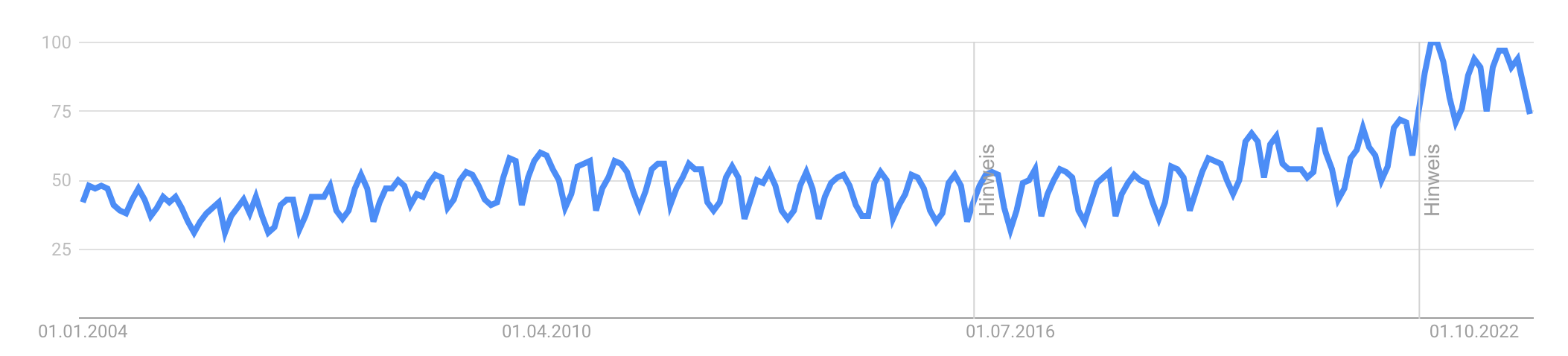
The indexed search interest on Google.com since 2004 for "Sustainability"
Source: Google (July 2023)
Even without them, the previously felt distant effects of global warming in the developing world appear to be at our doorstep sooner than some of us expected:
Weather anomalies such as flooding and extreme heat
Wildfires destroy homes and release tremendous amounts of CO2
Climate change's effects endanger some countries more than others, leading to an influx of refugees to more secure countries
...among other reasons.
For good reason: the CO2 amount in the atmosphere has risen dramatically over the last 200 years.
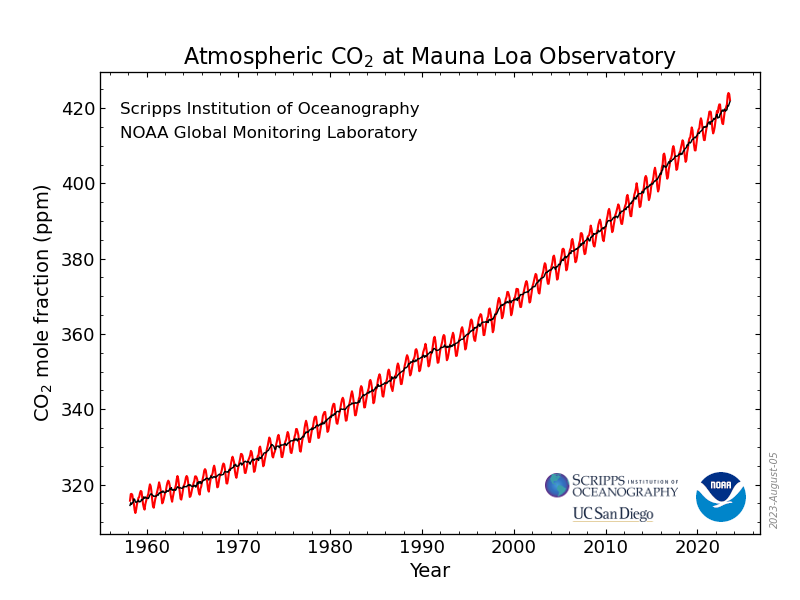
The CO2 amount measured at Mauna Loa Observatory, Hawaii
Source: Global Monitoring Laboratory (August 2023)
What is luxury's part in this? Where to start? And how significant is luxury on a global scale? Would contributions via sustainability tech even matter?
Luxury is less of a global driver of CO2 emissions than one may think. I'll show you why.
Let's look first at
a) what the sources of the current CO2 amounts are and
b) what we need to do globally to reach net-zero CO2 emissions.
Regarding a) Luckily, somebody else thought of this before me:
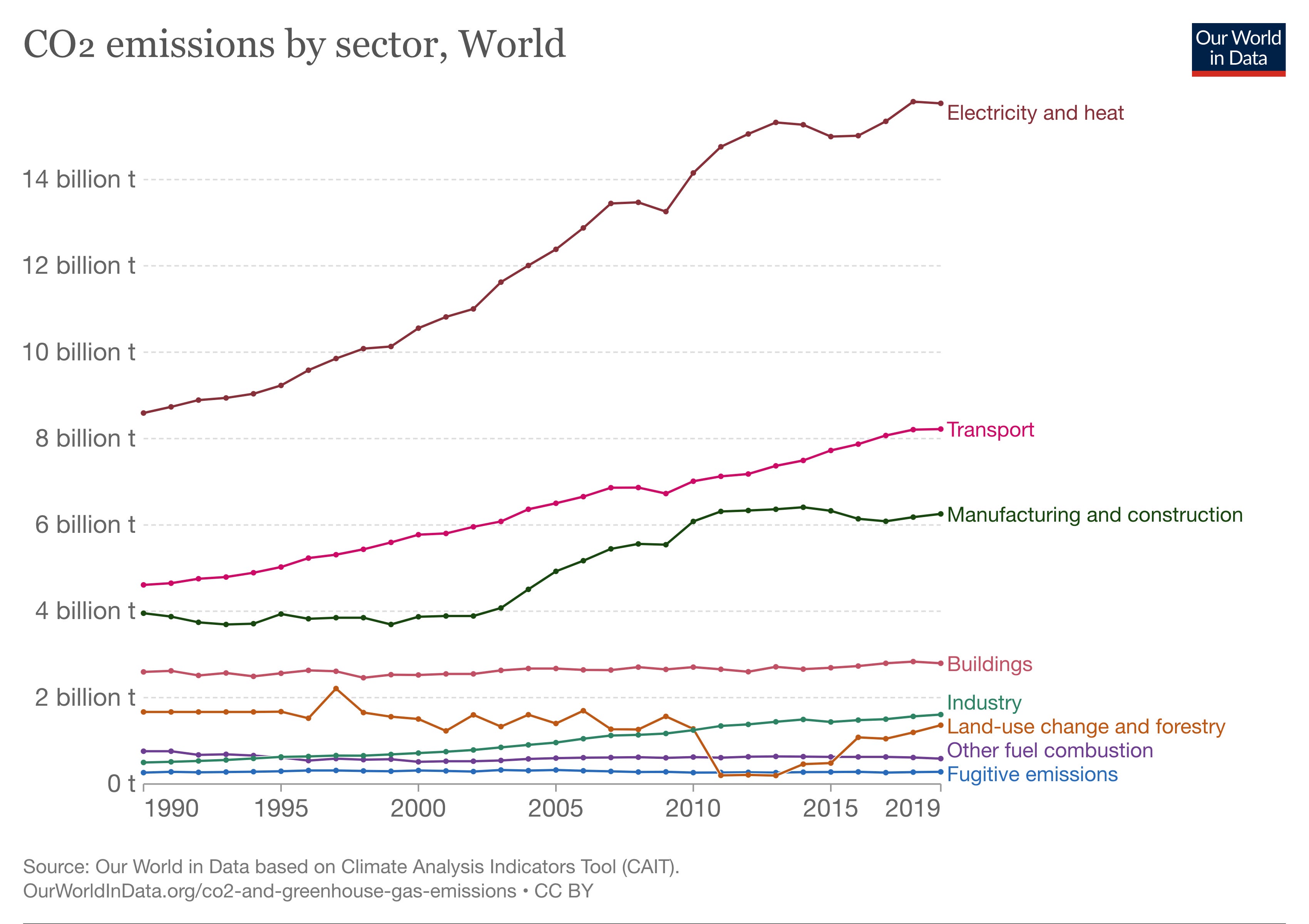
This chart is not cumulative. That means that in 2019, annual global CO2 emissions amounted to
c. 15-16 bn t from electricity and heat
c. 8 bn t from transport
c. 6 bn t from manufacturing and construction
c. 2.5-3 bn t from buildings
c. 1.8-1.9 bn t from industry
and c. 2 bn t from land-use change, forestry, other fuel combustion, and fugitive emissions.
Regarding b), John Doerr wrote an OKR-based plan to reach CO2 net zero emissions globally by 2050. See all of his proposed actions here. (Shoutout to Artur for gifting me this book.)
TL;DR → John Doerr's plan lists the following as key actions to get to CO2 net zero:
Electrifying transportation (i.e., reducing CO2 emissions in transportation),
Decarbonizing the grid (i.e., reducing CO2 emissions in energy production),
Fixing food (i.e., reducing CO2 emissions in producing food)
Protecting nature (i.e., ensuring natural CO2 absorption remains as high as possible)
Cleaning up the industry (i.e., reducing CO2 emissions in crucial industrial sources of production such as cement and steel),
Removing carbon (that already has been emitted and cannot be avoided)
Now, let's apply luxury to this initial situation.
Luxury is but a drop in the ocean of CO2 emissions - so why bother?
According to Deloitte (2022), the world's top 100 luxury goods companies generated revenues of USD 305 bn in 2021. According to the World Bank Group, that would equal a 0.3% share of the global GDP of USD 96.88 tn in 2021.
Let's assume that the top 100 companies only account for half of the total luxury sector's output and the full share of global GDP is 0.6%.
Now, let's put it in the context of our previously mentioned CO2 emission sources:
c. 100 m t from electricity and heat (applicable to stores and offices)
c. 50 m t from transport (applicable to transportation of goods)
c. 36 m t from manufacturing and construction (applicable to the production of goods)
c. 16.5 m t from buildings (unsure, but let's assume it's applicable somehow)
c. 10 m t from industry (not applicable since cement and steel in itself are pretty irrelevant)
and c. 2t from other (also, not applicable from my point of view).
Consequently, luxury amounts to 100 + 50 + 36 + 16.5 = 202.5 m t of CO2 emissions annually. This amount may even be exaggerated since the luxury segment's revenue to global GDP ratio may overstate the CO2 emissions in contrast.
For example, a ZARA shirt may emit the same CO2 emissions as a ZEGNA shirt, but its GDP/revenue contribution is fairly lower.
At the same time, some may argue that the revenue-to-GDP ratio is an entirely wrong figure to begin with so.. The 200m t figure is okay for this post.
In comparison, the only real difference between luxury and other segments is the manufacturing part. Every other part of CO2 emission sources is the same across all industries: electricity, heat, transport, and buildings. Nothing specific for luxury there.
Luxury-specific CO2 emissions are a drop in the ocean. So why bother?
Luxury is the frontrunner and others will follow
The simple answer is:
Every CO2 reduction counts
Luxury has a signaling effect that goes beyond its segment
Anything developed in luxury, from watches, cars, fashion, design, and more, is always the spearhead of innovation. Theoretically, it creates the newest at the highest quality and price levels. It has the highest media attention. The rest follows. (For more on this behavioral trait, read "Status and Culture" by W. David Marx).
If luxury firms go first, publish their results, and set an industry standard, it further differentiates their products and services, making them superior and more sustainable. Others will follow to close the gap.
Let's look at potential measures in luxury industries from a company's perspective along the value chain. They can be split into redesign, replace, re-use, integrate costs, and invest.
Redesign:
Design products that are easier to dismantle after usage
Replace:
Use less CO2-emitting materials
Re-use:
Re-use previously unsold materials instead of destroying them
Take in and re-use older products
Build and foster pre-owned markets
Integrate costs:
Integrate CO2 removal costs into retail prices
Enforce costs for the return of items
Invest:
Invest in new technologies, materials, and CO2 removal projects
A detailed look at the suggest measures
Design products that are easier to dismantle after usage:
Today's luxury items focus mainly on aesthetics and/or function. The design process stops at the sale to the user, leading to challenges when the product exceeds its lifetime. While textile-based products such as cotton t-shirts are less of an issue, highly integrated products such as sneakers, winter jackets, or a Tesla come with high costs for dismantling. Today's purchase prices do not incorporate these costs. Thinking further than just the sale and integrating a dismantling process makes re-using materials easier in the future, reducing the demand for additional resources and reducing pollution during destruction processes.
Use less CO2-emitting materials, re-use previously unsold materials instead of destroying them, and take in and re-use older products:
All three measures should reduce the CO2 footprint for sourcing materials by using new materials or reducing the need for new resources.
Much of today's production stems from newly sourced materials, of which a significant share comes from animals. One thing we learned from John Doerr's OKR plan is that to fix food and reduce food-related CO2 emissions, we need to eat more plant-based alternatives to meat. One implication is that anything animal-related in luxury, such as leather, damages the environment far more than it has yet been accounted for.
New materials must be developed and introduced to luxury products to reduce the animals' CO2 footprint. Segments include fashion, accessories, travel, and mobility. Excessive materials should be re-integrated into the production cycle. Especially in luxury fashion, companies destroy mountains of unsold clothing instead of re-using them.
Even though companies market luxury items of such high quality that they survive multiple generations, a specific lifetime can be assumed. Thus, after its final use, consumers should have the option to return the product to either dispose of it properly or make its resources available again to the producer. It doesn't matter if it's sneakers, cars or watches.
Build and foster pre-owned markets
One could segment today's secondary markets into three categories:
Thrift shopping of anything from used old plastic chairs to luxury watches and Porsches (e.g., eBay, craigslist)
Niche platforms for used items (e.g., Car & Classic, AutoScout24, Chrono24, Vestiaire Collective, Grailed)
Trading platforms of unused highly sought-after goods (e.g., StockX)
Third parties run these platforms and not the OEMs. It's reasonable since selling new goods is an entirely different game than trading used or aged items. These platforms exist for three reasons: to get awareness for suppliers, transparency for buyers, and to insert trust for all by the platform itself.
Still, people get scammed and buy counterfeits. Luxury brands have a unique opportunity to build and weave secondary markets of their goods into their offering:
They participate in a gigantic trading volume.
They know their products best, what to invest in, and how to ensure authenticity.
It attracts customers since they know what's at stake for the luxury brands' reputation.
Indeed, it's challenging to operate and requires additional know-how. Startups such as Archive tackle precisely this problem.
Integrate CO2 removal costs into retail prices and enforce costs for the return of items
Until today, retail prices do not account for costs for the impact of CO2 emissions. First lawsuits may lead to a restriction of fossil fuel development without considering its effect on the air quality, which would negatively impact people's health in the long-term. Companies could track and calculate their direct product-related CO2 emissions, derive a price for its removal or prevention, and integrate it into the retail price. At the same time, this cost increase should be directly funneled into respective investments and measures to prevent the accumulation of "CO2 emission tax" without action. In addition, the costs should only be for the product and not for the emissions caused by the company's operation. A price increase should be easy to integrate and resonate with consumers since prices for luxury goods increased tremendously at an average of more than 8% p.a., and consumers are still buying, proving that luxury goods have always had a lower price elasticity.
Integration costs for the return of items would have two effects: First, people would order less since their order requires a more substantial commitment. Second, the additional costs zero out emissions for unnecessary goods transport.
Invest in new technologies, materials, and CO2 removal projects
Someone must still invent the required solutions or require a market fit to scale. R&D is crucial. These solutions require investments, of which some may fail while others could be setting industry standards. Stella McCartney and LVMH developed a strong example of how this could look when they set up a $200m fund for climate-linked projects. Luxury watchmaker Panerai introduced steel watches where more than 50% of steel is recycled. Still, more is needed to ensure that sourcing and production in luxury industries can set a leading example.
Luxury drives innovation, and it should do so in sustainability, too
You see, this post has been different than my previous ones. Yet it feels that this one is the most important.
Luxury goods drive innovation, they spark joy, and they have the opportunity to change entire industries for the better. Even though its direct contribution is small, its global impact will be much more significant.